
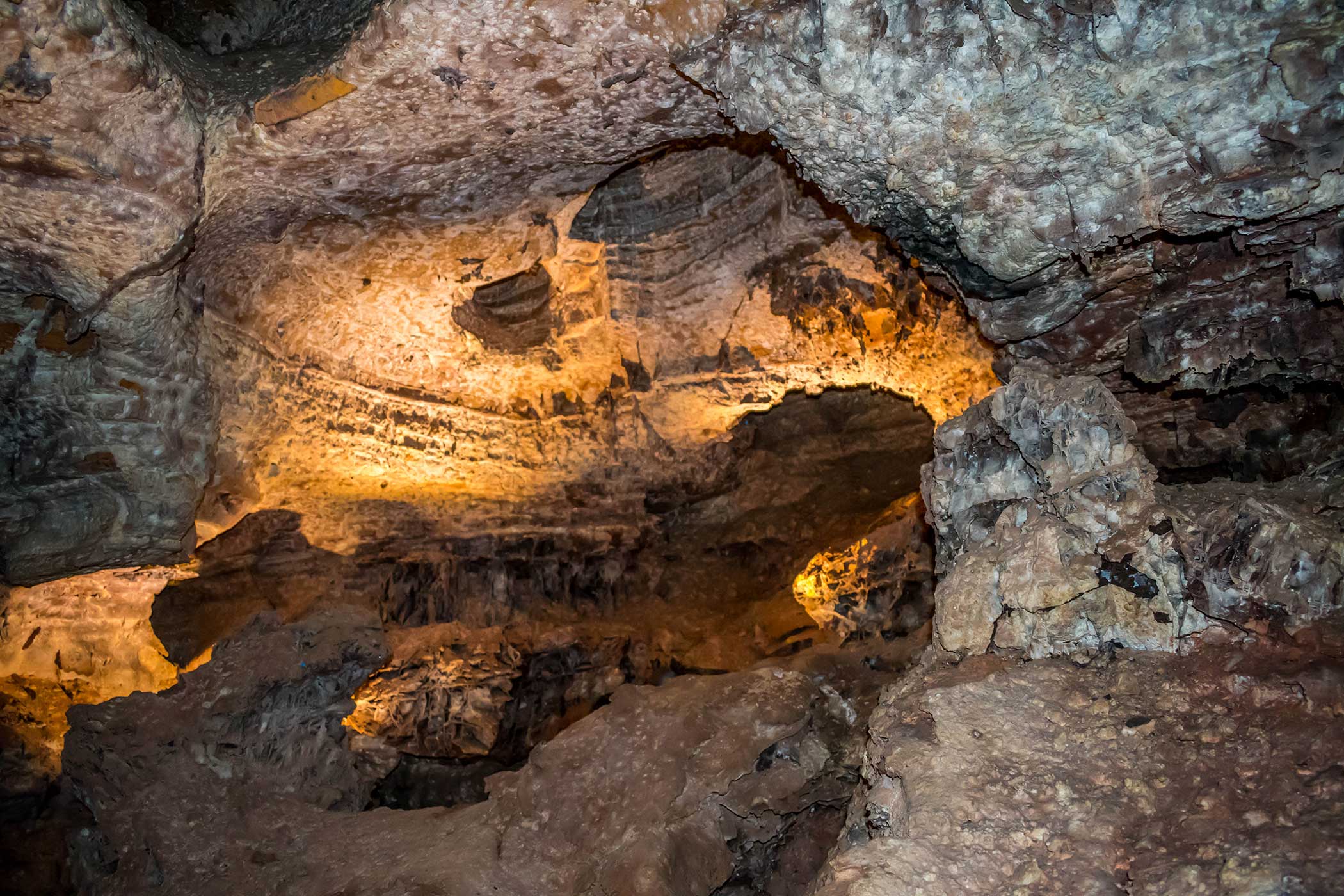
When you explore Wind Cave, you walk through a series of tunnels. So far, scientists have surveyed more than 140 miles of tunnels, but not all of those are open to the public. One of the most fascinating things about Wind Cave are the formations called boxwork. You can see these delicate structures that resemble a honeycomb or spider webs throughout the cave. Up close you can see the crystals on these formations that look like frosted flakes. These formations are crystalized fins left behind when limestone dissolved. And they’re rare.
You’ll also experience something known as the Natural Barometric Phenomenon. It’s a “breathing” phenomenon where air flows in and out of the cave entrance due to the atmospheric pressure changes.
There are six guided tours, with two of those tours only running in the summer. The tours also have varying difficulty levels. For example, you can choose from an Accessibility tour that lasts 30 minutes and is fairly easy or a summer Candlelight Tour that’s challenging and takes two hours with a total of 424 stairs, during which you’ll be required to bend and stoop while exploring less-developed areas of the cave carrying a candle bucket.
If you’re an advanced-level caver looking for the ultimate challenge at Wind Cave, the Wild Cave tour takes four hours and is described as “Very Strenuous.” The passages are not lit, and trail surfaces are uneven, wet and slippery. Some of the cave ceilings are low and some passages have a very steep grade so you’ll be required to bend, stoop, crawl and climb with most of the tour spent crawling on your hands and knees.